


Most drivers know their engine oil needs regular checks. Far fewer think about the other fluid their car depends on just as much - gearbox oil. In manual cars it is called gear oil; in automatics, transmission fluid (ATF). Either way, running low on it leads to overheating, accelerated wear and, in the worst cases, a failed gearbox - one of the most expensive repairs a car can need.
The good news: your car almost always warns you first. This guide, written by the experienced technicians at The Motor Company in Leicester, covers the seven warning signs of low gearbox oil, how to check the level yourself, which fluid your car needs, how often it should be changed, and what it costs in the UK.
Last Updated: 5 August 2026
The most common signs of low gearbox oil are delayed gear engagement (a 2–3 second pause when shifting), lurching or jerking, vibration through the gear lever, grinding noises, clutch drag, dark or burnt-smelling fluid, and - in automatics - transmission slipping. You can confirm the level via the fill plug on the gearbox casing (manual) or the transmission dipstick (automatic, where fitted) with the engine at operating temperature.
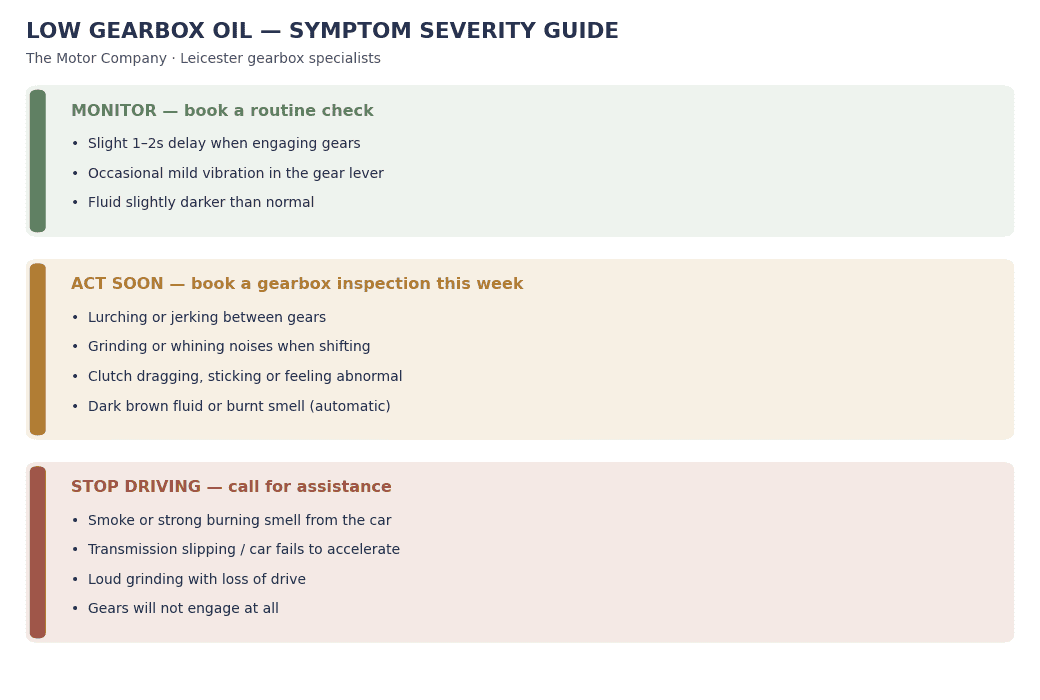
Is Your Gearbox Oil Low? Symptom Severity at a Glance
Not every symptom means the same urgency. Use this guide to judge how quickly you need to act - when in doubt, treat amber as red.

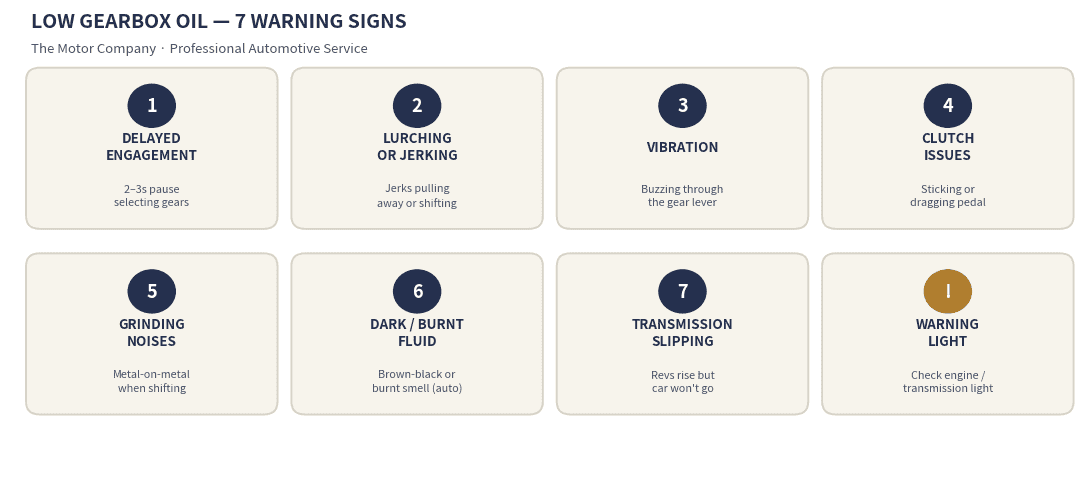
The 7 Warning Signs of Low Gearbox Oil
Manual and automatic cars share most of these symptoms; the differences are explained in the comparison table further down. If you notice two or more of these signs together, book a gearbox inspection before the damage spreads.

1. Delayed Gear Engagement
Low gearbox oil usually shows up first as a hesitation: a 2–3 second delay between moving the gear lever and the gear actually engaging. In automatics, you may notice the same pause when shifting from Park into Drive or Reverse. The delay happens because there is not enough fluid pressure to engage the gear cleanly.
A delay that is getting steadily worse over days or weeks points to a slow leak - check where you park for stains (see sign 7 and the prevention checklist).
2. Your Car Lurches or Jerks
Jerky, uneven movement when pulling away or changing gear can have many causes, but if there is no obvious explanation, low gearbox oil is a prime suspect. Without enough lubrication, internal components catch and release instead of gliding - and you feel that as a lurch.
3. Vibration Through the Gear Lever
Gearbox oil is a lubricant first. When the level drops, friction rises and you can feel it as a buzzing or vibration through the gear stick when changing gears - particularly in manuals. It often appears before any noise does, which makes it a useful early warning.
4. Clutch Problems - Sticking or Dragging
Many drivers assume springs alone return the clutch pedal. In reality, low transmission fluid can interfere with clutch operation: the pedal may stick in an abnormal position, or the clutch may drag - failing to fully disengage, which makes gears difficult or impossible to select. The good news is that a dragging clutch is sometimes fixed cost-effectively by adjusting pedal free play, but only if caught early. Our guide to diagnostic tests on car clutches explains how we confirm the cause before quoting.
5. Grinding or Whining Noises
Without enough fluid, the transmission overheats through friction and you will hear it: grinding in manuals, a whining or humming that rises with engine speed in automatics. Grinding means metal is wearing on metal - it is one of the most common manual gearbox problems we see, and every mile adds cost to the eventual repair. Book a gearbox service as soon as possible.
If the noise is accompanied by a burning smell or smoke, stop driving and call for roadside assistance - the gearbox is overheating and continuing to drive can destroy it within miles.
6. Dark or Burnt-Smelling Fluid (Automatic Cars)
Healthy automatic transmission fluid is typically red or pink and slightly sweet-smelling. Fluid that has turned brown or black - or smells burnt - has degraded and is no longer protecting the gearbox. Discoloured fluid is not just a symptom of low level; it is a sign the fluid itself needs replacing, not just topping up.
7. Transmission Slipping (Automatic Cars)
If the engine revs rise but the car fails to accelerate proportionally - as if the gearbox cannot hold the gear - the transmission is slipping. Low or degraded fluid is a common cause because hydraulic pressure is what holds automatic gears engaged. Slipping under load is an amber-to-red symptom: book a gearbox inspection this week.
Two more signs worth watching: the check engine or transmission warning light can illuminate when gearbox fluid is low - it is not reserved for engine faults. And puddles or stains where you park usually indicate a transmission fluid leak, the most common reason the level dropped in the first place.
Manual vs Automatic: How the Symptoms Differ
Both transmission types depend on fluid, but they fail differently. This table sums up what to look for in your car:
| Symptom | Manual (gear oil) | Automatic (ATF) |
|---|---|---|
| Delayed engagement | 2–3s pause selecting a gear | Pause shifting into Drive/Reverse |
| Lurching / jerking | Jerks when pulling away or shifting | Harsh or jerky gear changes |
| Vibration | Buzzing through the gear lever | Shudder under acceleration |
| Clutch / drive | Clutch sticking or dragging | Transmission slipping, revs flare |
| Noise | Grinding when shifting | Whining that rises with engine speed |
| Fluid check | No dipstick - fill plug on casing | Dipstick where fitted; colour & smell |
| Warning light | Check engine light possible | Transmission/check engine light common |
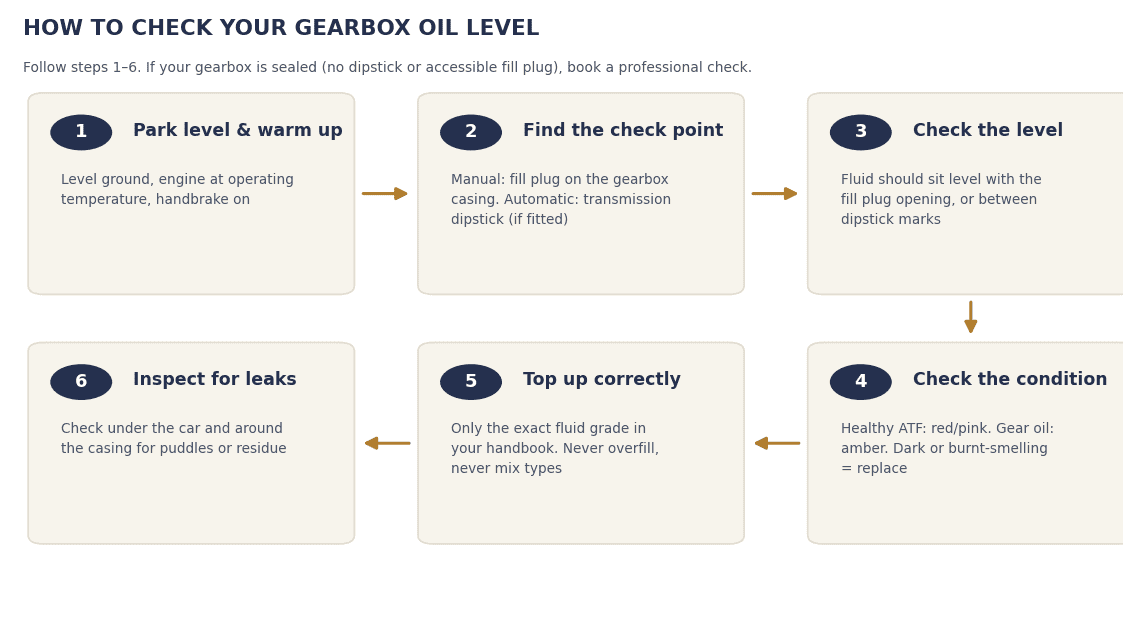
How to Check Your Gearbox Oil Level: Step-by-Step Guide
Unlike engine oil, most manual gearboxes have no dipstick - the level is checked through the fill plug on the side of the gearbox casing. Many automatics do have a transmission dipstick, but an increasing number of modern cars (especially DSG, CVT and “sealed for life” units) can only be checked on a lift by a garage. If in doubt, check your handbook - or book a check with us.
Step 1: Park Level & Warm Up
Handbrake on, on level ground. Check at operating temperature - fluid expands when hot, so a cold check reads artificially low.
Step 2: Find the Check Point
Manual: the fill plug on the gearbox casing. Automatic: the transmission dipstick (usually towards the back of the engine bay), if one is fitted.
Step 3: Check the Level
Fluid should sit level with the bottom of the fill plug opening, or between the dipstick marks. Low = top up or investigate a leak.
Step 4: Check the Condition
Healthy ATF is red/pink; healthy gear oil is amber. Dark, gritty or burnt-smelling fluid needs replacing, not topping up.
Step 5: Top Up with the Correct Fluid
Use only the exact grade in your handbook (see the fluid table below). Never mix fluid types and never overfill - excess fluid foams and starves the gearbox just as low fluid does.
Step 6: Inspect for Leaks
Look under the car and around the casing for residue or drips. A topped-up gearbox with a leak will be low again within weeks.

The fill plug on many manual gearboxes is only safely accessible with the car on a lift or ramps. Never work under a car supported only by a jack. If you are not confident, a professional fluid check takes minutes.
Gear Oil vs Transmission Fluid: What Is the Difference?
“Gearbox oil” is an umbrella term. What your car actually needs depends on the transmission type - and using the wrong fluid can be as damaging as running low. Manual gear oil is a thick, EP-additised (extreme pressure) lubricant; automatic transmission fluid is thinner and doubles as a hydraulic fluid that operates the gearbox itself. They are not interchangeable.
| Fluid type | Used in | Common specifications | Notes |
|---|---|---|---|
| Manual gear oil | Manual gearboxes | 75W-80, 75W-90, API GL-4 | GL-5 oils can corrode synchromesh rings in some gearboxes - check the handbook before choosing |
| Automatic transmission fluid (ATF) | Torque-converter automatics | Dexron VI, Mercon LV, manufacturer-specific | Works as lubricant and hydraulic fluid; degrades with heat |
| DSG / dual-clutch fluid | VW Group DSG, Ford PowerShift and other dual-clutch boxes | Manufacturer-specific (e.g. VW G 052 182) | Requires fluid AND filter change at fixed intervals - skipping it is the most common cause of DSG failure |
| CVT fluid | Nissan, Toyota and other CVT automatics | Manufacturer-specific CVT fluid | Never substitute standard ATF - CVTs use belts/chains that demand exact friction properties |
Always check the owner's manual first - the manufacturer's specification overrides any general guidance, including ours. Using the wrong fluid grade can cause as much damage as running low, and on DSG and CVT units the wrong fluid can void the warranty.
How Often Should You Check and Change Gearbox Oil?
Check the level at least once a year or every 12,000 miles, and immediately if you notice any of the seven signs above. Change intervals vary by transmission type - and by how the car is used (towing, city driving and aggressive use all shorten fluid life):
| Transmission type | Check level | Typical change interval |
|---|---|---|
| Manual | Yearly / 12,000 miles | 50,000–60,000 miles, or per manufacturer schedule |
| Automatic (torque converter) | Monthly where a dipstick is fitted | 40,000–60,000 miles |
| DSG / dual-clutch | Garage check at service | Around 40,000 miles - fluid and filter |
| CVT | Garage check at service | 40,000–50,000 miles |
Fluid intervals reward the same discipline as knowing how often to change the oil filter - small, cheap services that prevent big bills. And a word on “sealed for life”: some manufacturers claim the gearbox fluid never needs changing. In our experience, fluid always degrades with heat and mileage - what “lifetime” usually means is the expected warranty period, not the life of the car. The opposite myth is just as costly: garages selling fluid changes a gearbox does not need. Our approach is to assess your specific model, mileage and fluid condition, and recommend a change only when the evidence supports it.
How Much Does a Gearbox Oil Change Cost in the UK?
Costs depend mainly on the transmission type and how much fluid the job involves. Indicative UK prices for 2026:
| Service | Typical UK price (2026) |
|---|---|
| Manual gearbox oil change | £60–£120 |
| Automatic transmission fluid change (drain & fill) | £120–£200 |
| Automatic full fluid flush (complete exchange) | £180–£350 |
| DSG fluid & filter service | £200–£350 |
Compare that with the cost of ignoring low fluid: a gearbox rebuild typically runs £800–£1,500, and a full replacement can exceed £2,500. A £90 fluid change is the cheapest gearbox insurance you can buy.
Can You Drive with Low Gearbox Oil?
Short distances to a garage - usually yes, gently. Beyond that, no. Here is how the damage typically escalates when a car is driven on low gearbox oil:
- Stage 1 - Early wear: extra friction and heat. Fluid top-up or change fixes everything. Cost: under £150.
- Stage 2 - Component damage: synchromesh rings, bearings or clutch packs wear. Repairs run into several hundred pounds.
- Stage 3 - Gearbox failure: rebuild or replacement. Cost: £800–£2,500+. If you are already at this stage, our guide on how to know if your gearbox is broken explains what comes next.
Stop driving immediately and call for assistance if you notice smoke, a strong burning smell, loud grinding with loss of drive, or gears that will not engage at all. Continuing to drive at that point can turn a repairable gearbox into scrap within miles.
How to Prevent Gearbox Problems
Most gearbox failures we see were preventable. The habits that make the difference:
- Follow your vehicle's maintenance schedule - including fluid changes the manufacturer calls “optional”.
- Check your parking spot regularly for puddles and stains - leaks are the number one cause of low fluid.
- Use quality fluid of the exact specified grade - cheap fluids and unverified additives cause more problems than they solve. The same principle applies to engine oil - see our comprehensive guide on motor oils.
- Do not rest your hand on the gear lever while driving - the pressure wears selector forks.
- Do not ride the clutch, and avoid holding the car on the clutch on hills.
- Avoid sustained aggressive driving and towing beyond the rated limit - heat is the enemy of transmission fluid.
- Act on minor symptoms early. A £90 fluid change today beats a £1,200 rebuild next year.
From Our Workshop: What the Fluid Tells Us
When our technicians check a gearbox, the fluid itself is often the best diagnostic tool we have:
- Metal particles on the fill plug magnet are normal in trace amounts - but a thick paste of filings tells us bearings or synchros are wearing, and we plan the repair before the gearbox fails on the road.
- Milky or cream-coloured fluid means water contamination - common after flood driving or a failed cooler. This is one cause of gearbox failure that no amount of careful driving prevents, and it needs immediate attention.
- A burnt smell without dark fluid usually points to clutch wear rather than fluid age on manuals - a different repair entirely, and one reason we always diagnose before quoting. Our Ford Focus ST gearbox and clutch repair case study shows exactly that kind of job from start to finish.
Frequently Asked Questions
Yes. The check engine light is not reserved for engine faults - the engine control unit monitors the transmission too, and low fluid, slipping or overheating can all trigger it. Some cars also have a dedicated transmission warning light. Either way, have the fault codes read before topping up, so you know whether low fluid is the cause or a symptom of something else.
They do the same job - lubricating the gearbox - but they are different products. Gear oil is the thick, EP-additised lubricant used in manual gearboxes. Transmission fluid (ATF) is the thinner, multi-purpose fluid used in automatics, where it also works hydraulically to operate the gearbox. They are not interchangeable; always use the exact specification in your handbook.
Healthy automatic transmission fluid is typically red or pink and slightly sweet-smelling. As it degrades it turns brown, then black, and develops a burnt smell. Brown or black fluid needs replacing, not topping up. Healthy manual gear oil is amber to light brown; milky colouring indicates water contamination.
Often, yes - if you can safely access the fill plug or dipstick and you use the exact specified fluid. The risks are overfilling (which foams the fluid and starves the gearbox), using the wrong grade, and topping up a gearbox that is low because of a leak. If you are unsure, a professional check takes minutes.
Most manual gearboxes hold roughly 1.5–2.5 litres. Automatics hold 4–9 litres in total, though a drain-and-fill typically replaces only 3–5 litres - the rest stays in the torque converter, which is why a full flush exchanges more fluid. Your handbook lists the exact capacity.
The gearbox will destroy itself, sometimes within a few miles. Without lubrication, gears and bearings run metal-on-metal, overheat and seize. A car driven with a known empty gearbox should be recovered, not driven - the repair bill difference is a fluid change versus a full replacement.
A manual gearbox oil change typically takes 30–60 minutes. An automatic drain-and-fill takes about an hour; a full flush or a DSG fluid and filter service can take 1.5–3 hours depending on the vehicle.
Not directly - the MOT does not include a gearbox fluid check. However, a serious fluid leak can fail the MOT, and gearbox faults that affect safe control of the vehicle can too. You can see the full list of what is tested on an MOT - and an annual fluid check alongside your service keeps you ahead of both.
Yes - it is one of the most common causes in automatics. Hydraulic pressure holds the gears engaged, and low fluid means low pressure: revs rise but drive does not. Slipping under load deserves an inspection within days, not weeks.
In our experience, yes - eventually. “Lifetime” usually means the expected warranty period, not the life of the car. Fluid degrades with heat and mileage regardless of what it is sealed in. We assess the fluid condition and your vehicle's use, and recommend a change only when the evidence supports it.
Conclusion
Low gearbox oil never fixes itself - but it almost always warns you first. Caught at the hesitation-and-vibration stage, the fix is usually a £60–£120 fluid change. Left to grind, slip and overheat, the same problem becomes a rebuild or replacement costing ten to twenty times as much.
Check the level once a year, act on the seven signs early, and use only the fluid your handbook specifies. And if you would rather leave it to a specialist, our technicians will check your gearbox fluid with any booking - and tell you honestly whether it needs changing at all.
Book Your Gearbox Check or Service Today
Call us on 0116 287 0792, email themotorcompany@yahoo.co.uk.
Visit our garage at Golf Course Lane, Leicester LE3 1UY. All work is guaranteed from 1 to 5 years depending on parts and labour.